
Welcome to the Autism Alliance UK’s supporter newsletter.
If you’re receiving this newsletter, it’s because you have signed up as an Autism Alliance UK supporter. If you’d like to unsubscribe, click here.
Spring 2026

What is the Autism Alliance UK?
The Autism Alliance UK is the national body for specialist not for profit organisations that support autistic people and their families.
We work together to share our knowledge, skills and experience in ways which can improve outcomes and reduce inequalities for autistic people.
Our vision is a society where autistic people can thrive and live their lives in their communities.
To achieve this, we work with a wide range of people and organisations to influence Government policy and build a vibrant, supportive community of autism specialist organisations providing services and support.
You can read more about our work here and our members here .
In this newsletter:
Autism Alliance News – an update on the work we have been doing, including influencing and member news
Autism in the News - our round-up of some recent news stories about autism
Things you can do – focussing on actions you could take to help create a more inclusive employment environment
Tell us what you think– share your views about how public services could better meet autistic people’s needs
Autism Alliance News
As the national body for specialist autism organisations in the not-for-profit sector, the Autism Alliance UK continues to highlight the systemic barriers faced by autistic people across society and services, and the importance of addressing these to make a world in which autistic people can thrive.
Some of the main current developments in policy and public affairs are:
An interim report from the Independent Review into Mental Health Conditions, ADHD, and Autism commissioned by the Government in England. The Review is important because it deals with the fundamentals of diagnosis and ‘what autism is’ so has the potential to influence policy and public debate for years to come. The interim report found credible evidence of rising distress amongst young people which impacts on their lives and recognised the importance of meeting individual support needs. It also raised questions about consistency in autism diagnosis.
Increasing risk to the public perception of autism, through a focus on ‘overdiagnosis’. The Independent Review has shown that many factors working together account for the long-term increase in autism diagnosis across the UK, but the risk remains.
Despite this risk, strong support for autism-inclusive policy and approaches amongst many in society, including parents/carers, charities, and amongst many employers. This is important in continuing to address stigma and misunderstanding.
Continuing support for neuroinclusive employment amongst national figures, including the Mayor of Greater Manchester and Deputy Mayor of London.
Risk from the proposed SEND reforms in England, which could reinforce rigid approaches to education by providing another way to ‘divide children up’, rather than focusing on how to meet their individual support needs.
Alongside bringing UK autism not-for-profits together to share knowledge and improve services, the Autism Alliance UK leads work to influence public policy and commissioning, and to support public understanding.
A New Path Ahead, a report led by the Autism Alliance UK was released on 29th April. It was developed with autistic people, parents/carers, autism researchers, clinicians, and charities. The report was produced to influence the Independent Review and any response to the Review from the Government in England. A New Path Ahead makes one overarching point: that without long-term investment in systemic change, attempts to make public services more ‘needs-led’ will fail, because there is too much pressure on cost and staff to shift away from a model which restricts access to support and adjustments (currently on the basis of diagnosis).
We encourage all supporters to share the report with your own contacts and networks. Following A New Path Ahead, the Autism Alliance UK will be looking for opportunities to show how small steps in practice, funding and commissioning can lead to big changes at a system level.
The Autism Alliance UK will be responding to the consultation on SEND reforms in England. This will focus on the gap between the Government’s rhetoric on inclusion and belonging, and the reality of an education system which prioritises cost control and risks reinforcing rigid views of education just at the point when these need to change.
In the summer, the Autism Alliance UK expects to publish a new resource on the importance of specialist approaches in providing support for autistic children, young people, adults, and their families. With input from autistic people and their families, the resource will be to help those across the UK who commission local services, and to help individuals and families who are looking for support.
For Autism Acceptance Week 2026, the Autism Alliance UK focused on the fundamental state of autism acceptance and how it feels. Working with our members, we brought together videos and quotes on the theme ‘what autism acceptance means to me’ which can be found here and provide a resource to draw on for the future.
Working with autism charities active in UK public affairs, the Autism Alliance UK is considering how to support public understanding of autism, and address stigma, in a world with extensive misinformation. We expect further actions on this in due course.
Mainstream School Grant Applications Open
Autism Alliance member Sheila Coates Foundation have announced the opening of two new funding rounds offering £5,000 awards to mainstream secondary schools and colleges across England to support autistic students.
These small grants help autistic students thrive by supporting quick, practical solutions. Support for autistic young people in mainstream education is highly variable, and timely interventions can make a real difference.
Please share the link with your own affiliated mainstream schools.
Downloadable Toolkit for Secondary School Pupils
Alliance member Ambitious about Autism have created a free, downloadable resource for use in every secondary school within the UK.
The Autistic and OK programme, in collaboration with Zurich and the Z Zurich Foundation, aims to empower autistic pupils to take control of their mental health and wellbeing, understand themselves and feel OK.
Please explore, share and use this fantastic resource within your own communities.
Autism in the News
Autism research: “We have to get away from us-versus-them thinking”
“Whenever she hears someone talk about autistic people in terms of ‘they’, the hairs on Carolien Rieffe’s neck start to stand up. That one little word is so telling. ‘We are here, and they – autistic people – are somewhere else,”
Professor at the University of Leiden in the Netherlands, Carolien Rieffe is pushing for a new approach called “Critical Design” which encourages researchers to examine their own cultural and social background and how these influence their research, in order to critically analyse these assumptions to remove prejudice and othering.
‘Money Talks’ event to empower neurodivergent founders
The North East Combined Authority has partnered with NatWest Accelerator and neurodivergent-led programme Business Unmasked to deliver Money Talks, an interactive research event taking place on May 11 at The Lumen building, in the Newcastle Helix district.
The session will bring together up to 50 neurodivergent founders to explore their experiences of accessing finance, their relationship with money and the barriers they face when seeking support.
Neurodiversity belongs in social work: lessons from our campaign
59% of 656 social care worker respondents to a Community Care poll said their work place was ‘not at all’ or only ‘a little’ inclusive of neurodivergent colleagues.
Community Care’s campaign was launched to bridge this gap and show employers simple changes they can make to create inclusive, and therefore more productive, workplaces. It also highlighted the huge advantages having neurodivergent staff supporting neurodivergent clients and the natural empathy that can come from that, as well as often being very skilled in creative problem-solving and attention to detail.
Neurohaus - helping brands design neuroinclusive retail experiences
Neurohaus was co-founded in 2023 by husband and wife Olly and Amelia Markeson. A former brand strategist, CEO Olly was diagnosed with ADHD and dyslexia as an adult. Amelia was diagnosed with ADHD and autism shortly after, and the pair’s attempts to navigate life through the lens of neurodivergence revealed just how needed Neurohaus was.
Roughly 20% of consumers are neurodivergent but most brands overlook them. From a business perspective it’s a missed opportunity, from a human perspective it just makes sense.
Schools pioneer SEND student inclusion scheme
Field Lane Primary is actually two Rastrick schools in one. The number of pupils had been falling at Field Lane, but the nearby specialist Highbury School had a waiting list.
A partnership between Polaris Multi Academy Trust, which operates Field Lane, the local authority and Highbury has seen a "co-located" school established with a growing register. At its heart is a pioneering approach to improve inclusion of SEND pupils in the mainstream, according to teachers.
Town working to become Donegal’s first ‘autism-friendly town’
The Autism Friendly Town Committee in Castlefin, Ireland, is made up primarily of parents of autistic young people. The group are using their own experience to bring in simple changes to the businesses in the town, to try and make life just a little easier for autistic people and their families.
Introducing quiet areas, sensory-friendly hours, visual guides and training staff in local businesses are just a few of the measures the team are implementing.
Things you can do
The Autism Alliance’s vision is a world where autistic people can thrive and live their lives in their communities. In this section we are focussing on neuroinclusion in employment. Autistic people face some of the lowest levels of employment within our society - around 30%. Here we share useful information, links and ways you can help to change this.
The Bee Neuroinclusive Code of Best Practice
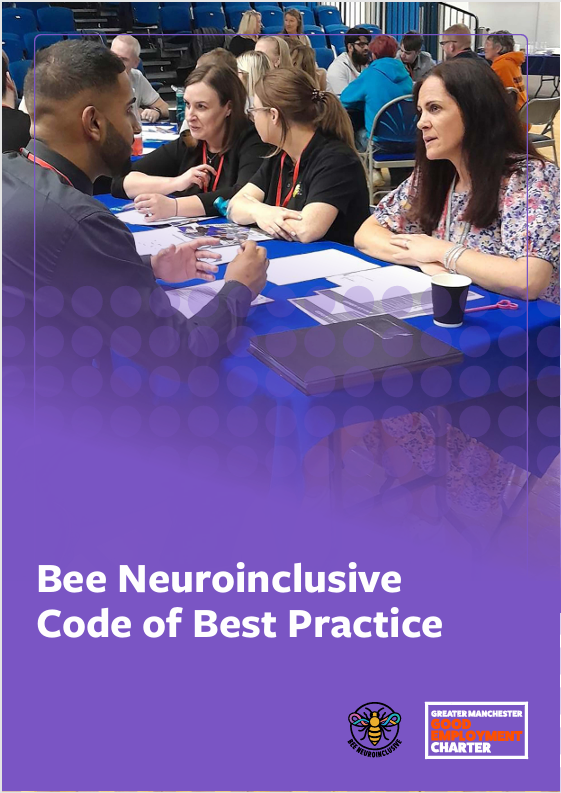
Part of the Greater Manchester Good Employment Charter, the Bee Neuroinclusive Code of Best Practice is an accessible and well informed guide on including and supporting neurodivergent colleagues. Greater Manchester Mayor Andy Burnham says, “Neurodivergent people bring perspectives and problem-solving ability that can transform workplaces and drive progress.”
This easy to use guide can be shared and implemented by employers as well as those overseeing employer collaboration in regional/local areas, and can also help neurodivergent people identify the support and adjustments they may need.
Ausome Charlie
Charlie Hart is an autistic keynote speaker who specialises in making workplaces more neuroinclusive. We have been lucky to have Charlie present at the Autism Alliance and her work has had a real impact. For both employers and employees alike, Charlie’s work contains a wealth of knowledge and value, and most importantly - from someone with real experience.


Neurodiversity Employers Index (NDEI)
Autisica, the UK’s leading autism research charity, have developed the Neurodiversity Employers Index (NDEI), providing evidence based tools, training and consultancy to workplaces. This is a gold standard tool for employers looking to improve practice. For employees, this is a tool for sharing with management as well as gaining knowledge yourself - for example, what to expect in a supportive work environment as well as which employers are NDEI award winning organisations.
“We know neurodiverse teams perform better. A thriving organisation needs big-picture thinkers, people who notice the crucial details, team players, innovators and creative problem solvers.”

Ambitious About Autism - Employer awareness
Education charity, and Autism Alliance member, Ambitious About Autism have produced a number of excellent tools for employers and young people, designed to improve awareness and opportunities for neurodivergent employees.
These include support and advice on recruitment, training, consultancy as well as Employer Toolkits for both employers and young autistic job seekers.

Find a wealth of knowledge about success in the workplace at Genius Within, founded by Dr Nancy Doyle and a leading UK provider of neurodiversity services for business, non-commercial organisations and individuals.
In addition to vital services and support for employers, Genius Within also provides many helpful resources designed to share lived experience and increase understanding.
Tell us what you think
Neuroinclusion in the workplace
Autistic people face some of the greatest inequalities in the field of employment, with an estimated 7 in 10 autistic people unable to access meaningful work. We hear weekly from people who very much want to work but are denied even the smallest of reasonable adjustments, as well as a growing cohort of exceptional self-employed entrepreneurs sharing amazing skills and reshaping the conventional world of work.
We would love to hear your experience and stories; successes and challenges, hopes and dreams, and what you think would help to change this unacceptable statistic.
A final word
We hope you enjoyed reading this newsletter. We’ll send out a new edition every quarter, keeping you updated on our work, but if you’d prefer not to hear from us again, you can unsubscribe here.
If you know someone who supports our vision for a world where autistic people can thrive, you can share our supporter page with them so they can receive the newsletter too.
