A first look at the Government’s proposals for SEND reform
Key tests for the Government’s proposals for SEND reform
The Government has today (23rd February) published its long-awaited plans for education and SEND reform. Here are some initial reflections following a first look at the proposals. The first take is that there are some positives, but also some risks - and that a huge amount rests on implementation.
Timeline
The plan is long-term. Ten years feels like a long time, but turning around a system in such dire straits needs this time: the stakes are too high to get this wrong. In the meantime, the Government’s intention to ‘invest up front’ needs to reap rewards for the children and young people already in education, and turning money into different outcomes as soon as possible needs to be a priority for implementation. Staging reforms is vital, and the shift to Education, Health and Care Plans for children and young people ‘with the most complex needs’ will need to be managed extremely carefully, monitoring for any potentially negative effects associated with setting thresholds and ensuring that children and young people’s needs continue to be met at all times.
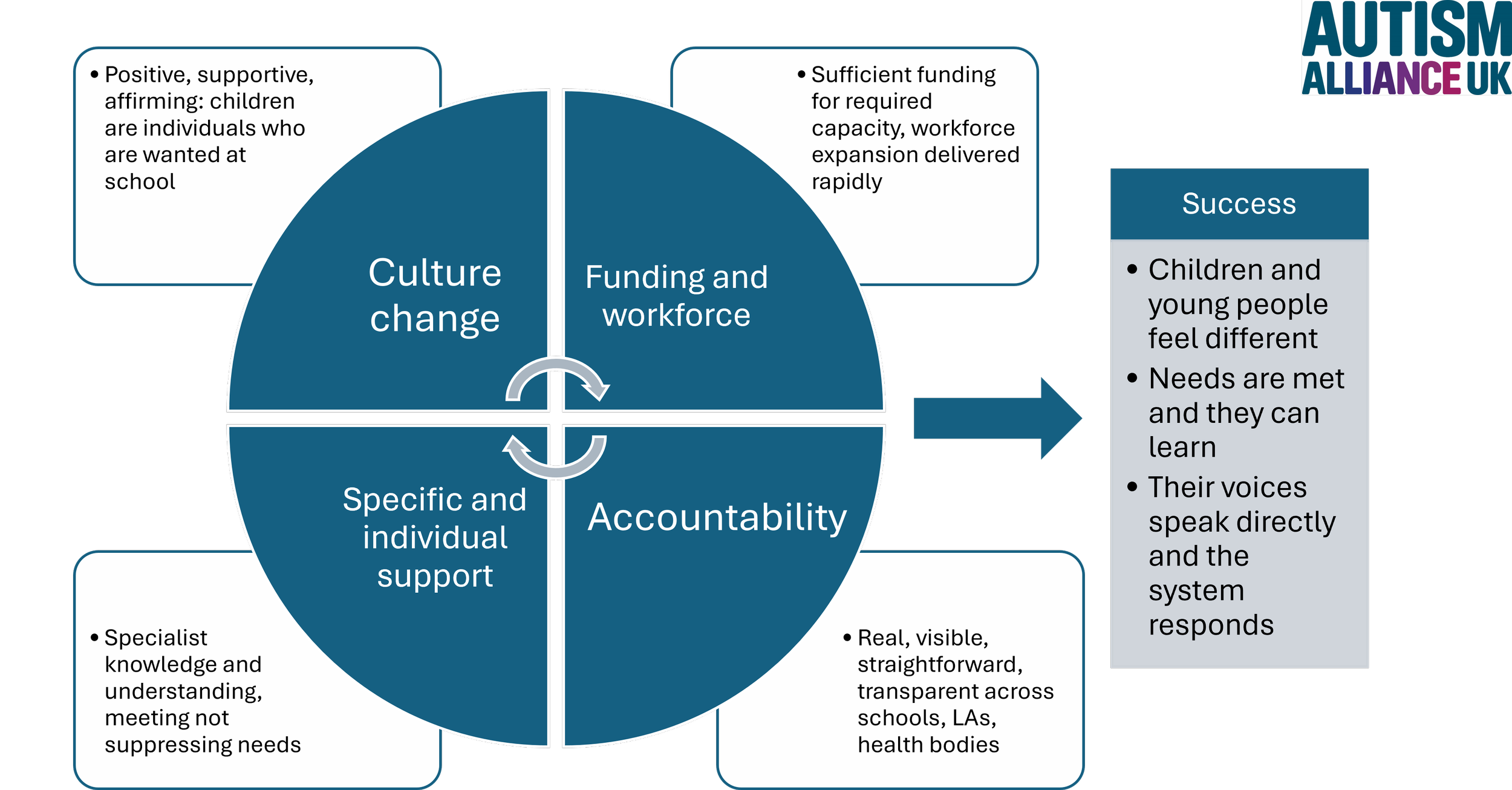
Culture change
The Government’s plans are ambitious and positive but will depend fundamentally on culture change. Realising the commitment that every child should feel they belong is vital: it is also a huge undertaking given the present position, and without culture change in significant parts of the education sector, will fail. As noted in the Neurodivergence Task and Finish Group report, for all children and young people to feel that they below, education must have a positive, supportive, affirming culture that stops treating children as problems to be fixed, and starts seeing them as individuals who are wanted in school. Culture is at the core of everything: it is the wording through the stick of rock.
Changing culture is perhaps the Government’s biggest challenge given the damage done up until now. Culture is steered heavily by the overall aims of education, and it is vital to ensure that any focus on ‘high standards’ does not, as it has in the past, simply override wellbeing and attempts to recognise and meet children’s needs. Changing the system through inspection frameworks, National Inclusion Standards, Experts at Hand, and Individual Support Plans, can - and hopefully will - help attitudes to shift: but culture should have its own distinct focus in the reform strategy, and culture change will need clear, sustained leadership from the Government, starting now.
Funding and workforce
An essential prerequisite for culture change is sufficient funding. A system that remains under intense financial strain is likely to stay as it is. Equally, achieving the vision for early and continuing support set out in the White Paper will require investment to recruit, train and retain a larger specialist workforce: the Government has made this commitment, but the expansion will need to be rapid. Capacity and skills will be vital both in schools/settings and in local authorities.
Accountability
The changes proposed, including new statutory duties on schools to ensure support, are positive but accountability needs to be real, visible and straightforward, whether around EHCPs or the support set out in an Individual Support Plan. How local authority accountability is secured will be crucial; and again, a well-functioning system will depend heavily on culture: people and organisations that want to prioritise the right things because they believe they are right, across schools, local authorities, and health bodies. Transparency - for example, through Inclusion Strategy Reports from schools and trusts - will be vital.
Success
The true test of success will be whether children and young people feel different and that things have changed. Do they agree that they feel like they belong, and that they are wanted? Is this true wherever a child or young person is learning, and across both mainstream and specialist settings? Who is asking them, when, and how? The plans for a Pupil Engagement Framework, and the planned role for the Children’s Commissioner, are positive. But the key will be how directly the voices of children and young people are enabled and allowed to speak, and how transparently the system recognises and acts on what they say. The Government will need to be honest with parents and the public at every stage, and if things aren’t working, act immediately to fix them.
Specific and individual support
A key risk in the proposals is that support is not sufficiently informed by specific knowledge and understanding relating to different aspects of SEND, including different types of neurodivergence; and that support does not identify clearly enough or respond to the individual differences of each child or young person. One obvious example is autistic masking and burnout: without specific knowledge, understanding and expectations that recognise how masking works, and when burnout is likely, there remains a risk that many autistic children and young people’s needs are missed or ignored.
Equally, looking at the ‘areas of development’ proposed for an updated SEND Code of Practice, as these are adopted as a basis for support it will be vital that the system moves away from a normative, deficit-based culture. Educators must understand how to meet needs rather than suppress them, and how one can very easily become the other.
Specialist expertise will be essential at every level as the plans are implemented, and it is positive to see a stronger role proposed for specialist organisations in supporting mainstream schools and settings. But banding support into tiers carries the obvious risk that specific and individual needs are missed or papered over, which would undermine the policy intent. And we need to guard against a ‘presumption against specialist’ in policy and commissioning, as this could drive the distribution of provision, where it needs to evolve over time, always following need.
This is only an initial view, and a much more detailed reading is required. Working with our members across the autism specialist not-for-profit sector, we will be reviewing the plans in full during the weeks ahead and making a formal submission to the Government’s consultation.